The sourcing channel determines the quality of your candidate pool before a single resume is reviewed. Relationship-based channels arrive pre-screened — by people who have seen the work firsthand. Stranger-based channels rely on filters that can barely tell the strong from the weak.
Hiring strangers forces you to infer all four dimensions from credentials and keywords — signals with almost no predictive power. Hiring people you know means you already have direct evidence on each quadrant before the process begins.
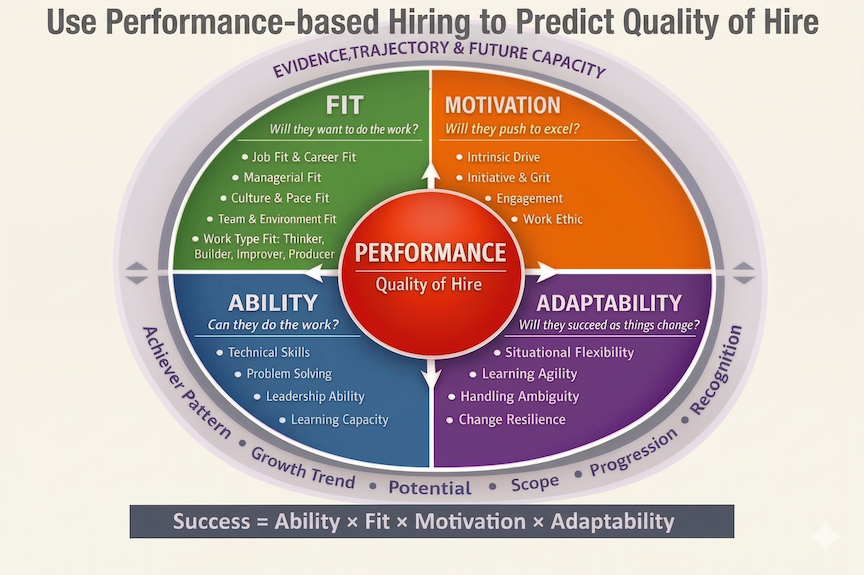
The more quadrants you have direct evidence on, the higher the implied diagnostic ratio — and the higher your confidence in the hire before the process even begins.
The sourcing channel is the screen. Everything else is noise reduction.
Most companies try to solve hiring quality by improving their filters — better keyword screens, cognitive tests, personality assessments, AI interviews. The data shows this is the wrong lever. These tools screen strangers using signals that appear at nearly the same rate in strong candidates and weak ones alike. When a signal can't tell the difference, it adds almost no confidence to the hiring decision.
This is what the diagnostic ratio measures — how much more likely a signal is to appear in a strong candidate than a weak one. A ratio of 1.0 means the signal fires equally on both groups and tells you nothing. A ratio of 5x means it is five times more likely to flag a strong candidate. Keyword filters and credential matching have diagnostic ratios near 1.1x. Watching someone do the work for two years has a ratio near 8–10x. That gap is the whole story.
Relationship-based channels bypass the credential proxy problem entirely. When a manager has seen the work firsthand, when a colleague vouches for performance, when a re-hire returns with a track record — the screening has already happened, on the job, against real outcomes. The pool arrives pre-qualified. That is why an internal promotion enters the process at 75% prior confidence and exits with 96% post-screen confidence — before a single structured interview is conducted.
Stranger-based channels start at 10–15% and keyword screening moves them to 17%. The same structured interview that confirms a known candidate at 97% can only get a stranger-sourced candidate to 26% — because the prior the interview receives is so much weaker. A good interview cannot rescue a bad pool. Fix the pool first.
The Performance-based Hiring Talent Hub gives you the frameworks, job description templates, screening tools, and interview guides to put this approach into practice — across every sourcing channel.
Visit the PBH Talent Hub →