Transform recruiting from reactive chaos into proactive excellence. Apply Toyota's revolutionary Kanban system to talent acquisition.
Global recruiting spend with minimal returns on investment
Less than 1 in 200 applicants actually get hired
Half of new hires underperform or leave within 18 months
Traditional hiring is reactive, volume-driven, and designed to filter out the unqualified after a job opens. It's a weeding-out process built around skills-laden job descriptions that attract people looking for lateral transfers at slightly more pay.
You can't attract the best with job descriptions designed to weed out the weak. The wrong strategy drives the wrong process.
Reactive — scrambling when someone quits
Proactive — building relationships months ahead
Volume-driven with bloated applicant pools
Flow-based with right-sized talent pools
Skills-based filtering that misses top talent
Performance-based matching that expands pools
Attracts lateral moves for more pay
Attracts ambitious people seeking growth
When Toyota introduced Kanban in the 1950s, it revolutionized manufacturing. The same logic transforms talent acquisition: less waste, lower cost, higher quality, faster throughput.
Begin with a rolling 6–12 month plan by job class. This shifts recruiting from reactive scrambling to proactive relationship building. When a role opens, candidates are already in the pipeline.
Define work as performance objectives, not skills lists. This opens talent pools to high performers with different skill mixes but comparable accomplishments. No more keyword filtering that misses top talent.
Maintain genuine engagement with high-performers who fit critical role profiles. When circumstances align on both sides, conversations are warm — not cold outreach to strangers.
Stop paying to post hundreds of jobs and process thousands of unqualified applicants. Smaller pools mean less screening and fewer wasted interviews.
Workforce planning plus nurtured talent pools means candidates are ready when needs arise — not weeks of scrambling after a resignation.
Performance-based descriptions attract people seeking career growth. Relationship-based sourcing means you know candidates before you need them.
When both sides are choosing rather than settling, commitment is stronger and results are more predictable.
Hires made for career opportunity stay longer than hires made for incremental pay bumps. Regrettable turnover drops.
Résumé fraud and AI-generated applications are symptoms of high-volume systems. Smaller pools and performance-based criteria eliminate the conditions that create fraud.
Stop posting individual jobs. Instead, publish one 6×6 Career Matrix per job family — Engineering, Sales, Operations — and let candidates find themselves within it. They design their own career path; you get pre-qualified applicants who've already mapped their fit.
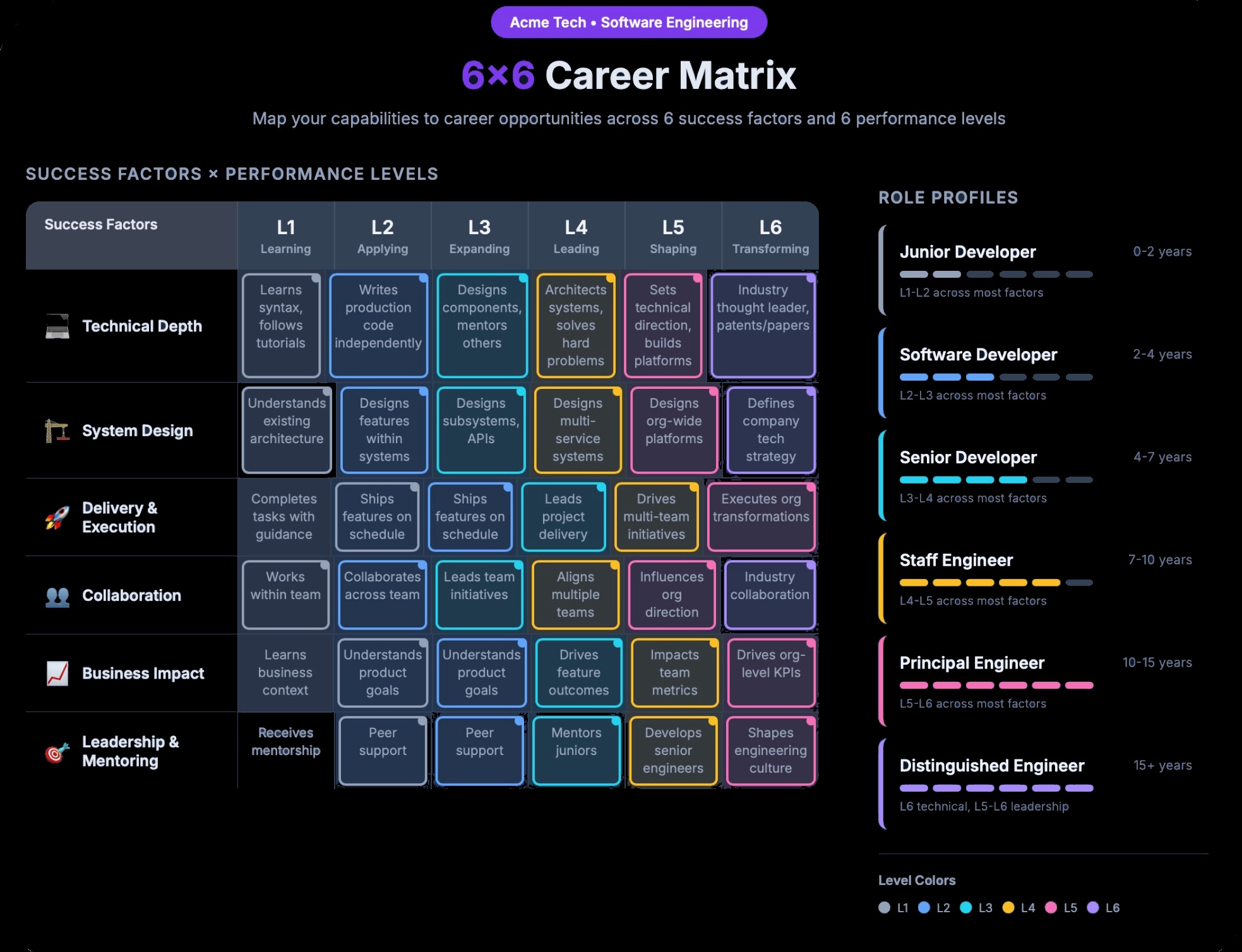
Instead of scrolling through dozens of postings hoping one fits, candidates explore the matrix and identify where their accomplishments place them today — and where they want to grow. No more "Apply Now" buttons. Just career conversations with people who've already done the work to understand their fit.
One Engineering matrix replaces Senior Engineer, Staff Engineer, Principal Engineer, and Engineering Manager postings. Consolidation means less noise, better candidates, and faster time-to-fill.
Candidates see exactly where they fit today and where they could grow tomorrow. The right people opt in; the wrong ones opt out — before you spend a minute screening.
Skills-based postings attract people seeking 10% more pay. Career matrices attract ambitious people seeking their next chapter — the ones who stay and grow.
You can't keyword-stuff a career matrix. Candidates must demonstrate accomplishments that map to specific performance levels — not just claim skills on a résumé.
"Toyota didn't fix manufacturing by sorting faster. They redesigned the system. Hiring deserves the same."
Kanban for Hiring is powered by the Talent Hub — the engine that makes Performance-based Hiring actionable. Build your own performance-based job descriptions, create candidate-facing career matrices, and implement the entire methodology in one platform.
Kanban for Hiring is a component of Performance-based Hiring — a methodology proven over 40 years to attract and hire stronger talent.