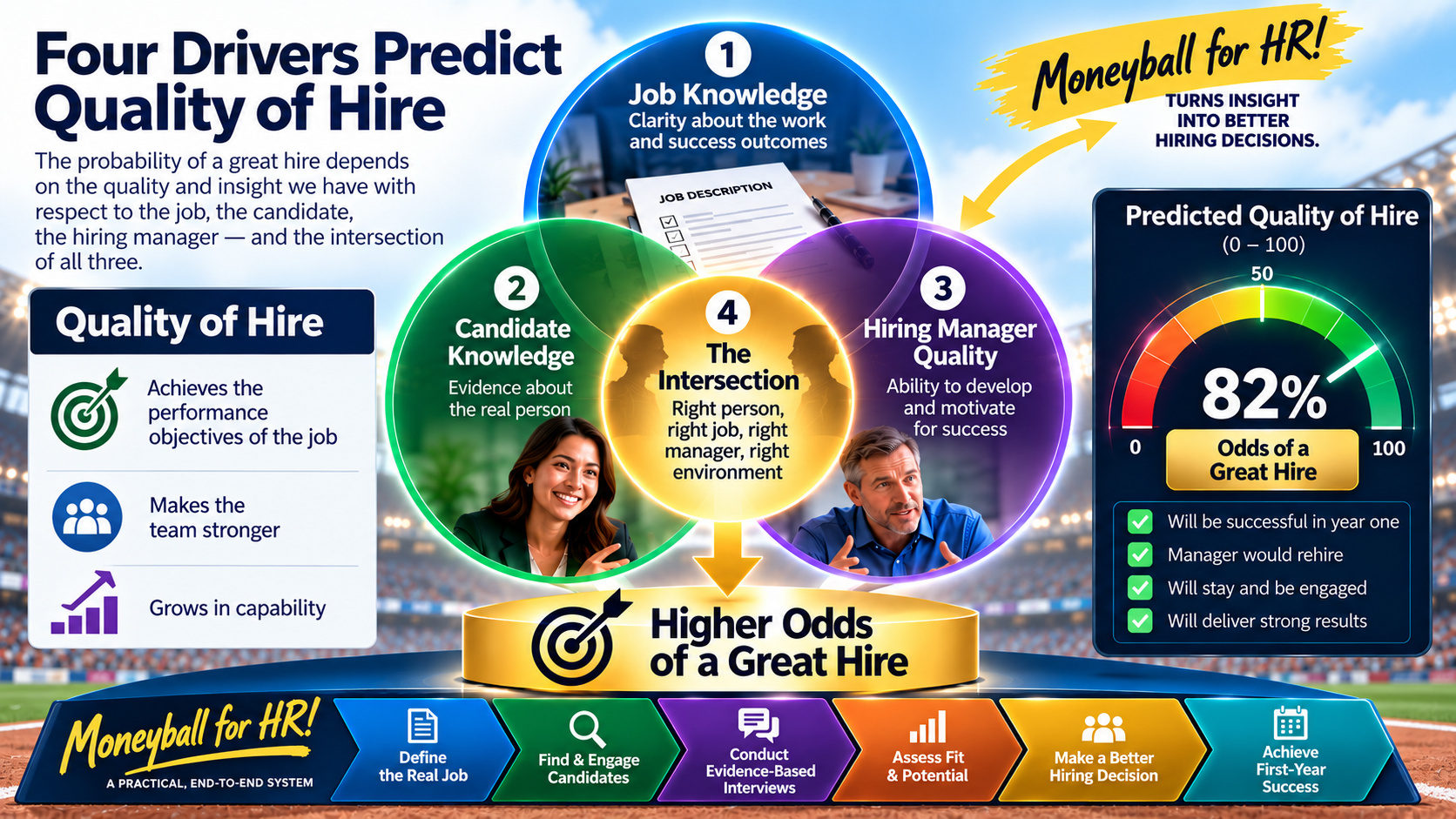
The Quality of Hire Predictor
A Moneyball for HR! tool. Replace the interview audition with the evidence that actually predicts success, and turn every hiring decision into odds you can measure.
What are the odds the candidate you're considering will exceed the performance objectives of the job?
Quality of Hire is how well a new hire achieves the performance objectives of the job, measured at the one-year anniversary. A Great Hire exceeds the objectives, makes the team stronger, and is ready for more. The predictor forecasts Quality of Hire before you make the offer.
View Sample ReportSee what strong evidence looks likeClose the gap between the people you know and the strangers you hire
When you promote someone you've worked with, you already know the job, you know the person, and you know how they'll work with their manager. That's why internal promotions and returning employees succeed more often than outside hires. With a stranger, you usually know almost none of it, so the decision falls back on résumés, years of experience, and a good interview, which barely predict success. The result is both kinds of hiring mistakes: Type 1, hiring the wrong person, and Type 2, missing the best person because they didn't shine in the interview.
Knowing someone well doesn't make them a great hire. It makes the outcome predictable, in either direction: you know whether they've excelled at this kind of work, and whether the job is right for them. The predictor shows how to close that gap: gather the same knowledge about a stranger that you'd have about someone you know, and measure every candidate on the factors that actually predict success after the hire.
Select any of the three to load it into the predictor below.
How the predictor works
Four factors decide it: Knowledge of the Job, Knowledge of the Candidate, the Quality of the Hiring Manager, and how well the three come together into a real career move. Rate what the evidence shows for the person in front of you. The predictor shows the odds for this candidate, whether you have enough information to make a confident yes-or-no decision, and which evidence would change the odds most. Most candidates start with about a 15% chance of being a Great Hire and a 50% chance of being a hiring mistake.
Help us test it: join the Quality of Hire study
Try the predictor on people you've already hired, one who excelled and one who underperformed, and tell us whether the odds match what happened. Your ratings become part of an ongoing study of what predicts Quality of Hire. Join the study
What a "Top 25% Performer" means
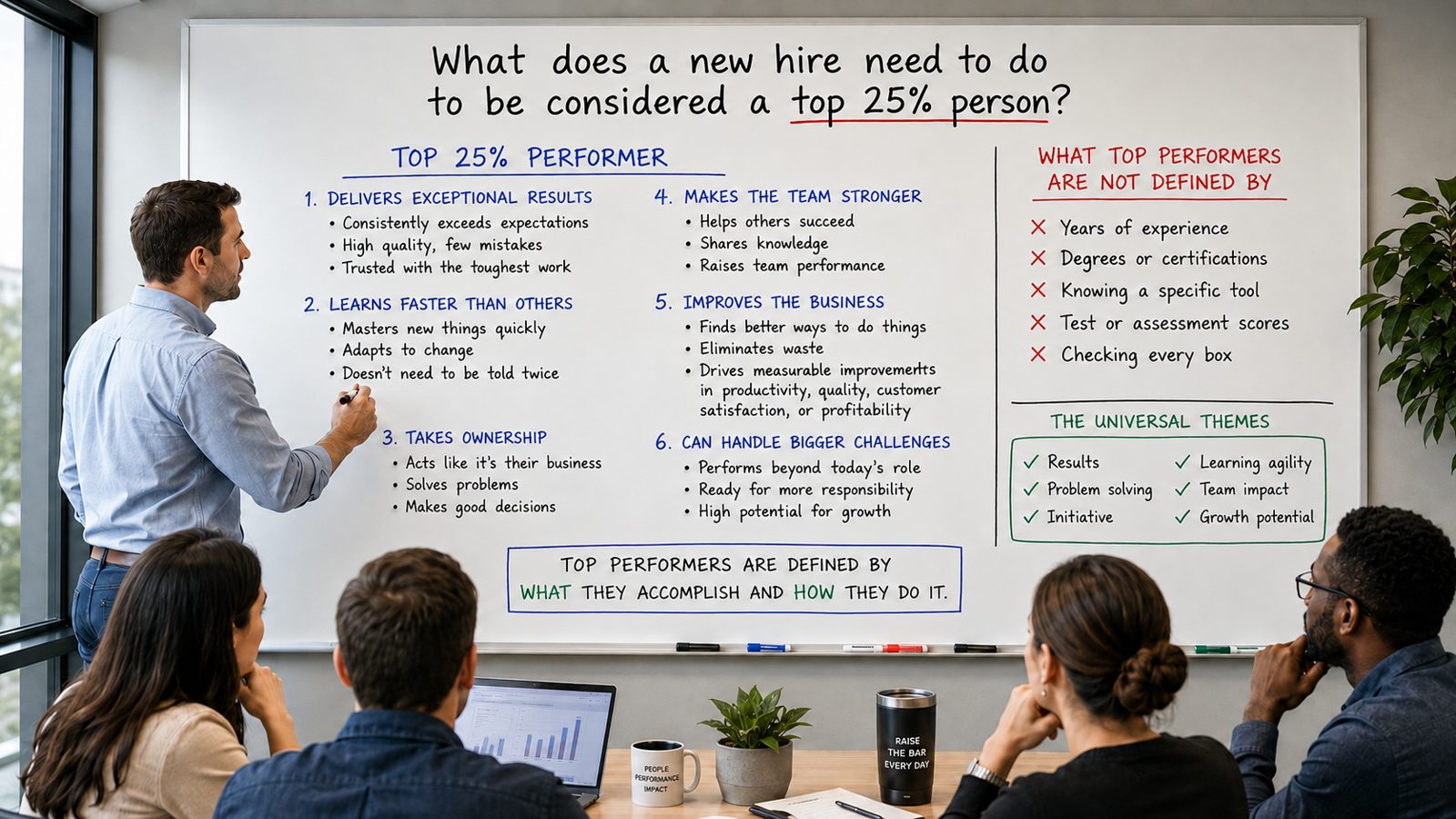
It's a standard of performance, not a ranking. Any number of people can meet it, and a Great Hire is someone who meets it in their first year. A Top 25% Performer:
- Delivers exceptional results
- Makes the team stronger
- Learns faster than others
- Improves the business
- Takes ownership
- Can handle bigger challenges
It isn't defined by years of experience, degrees, knowing a specific tool, test scores, or checking every box. Top performers are defined by what they accomplish and how they do it.
Moneyball for HR!
Data analytics started in baseball and now drives every major sport. Moneyball for HR! brings the same discipline to hiring, with one goal: stop both kinds of hiring mistakes. Type 1 is hiring the wrong person. Type 2 is not hiring the best person.
The Quality of Hire Predictor addresses both. The four factors below show when the evidence says no, and when it says yes to a strong candidate a typical interview would have missed.
Why these four factors predict Quality of Hire
People rarely fail in a new job because they lack the skills on the checklist. They fail because of everything else: they aren't motivated by the actual work, they struggle with the team or the pace, or they clash with the hiring manager. Traditional hiring measures the checklist and leaves everything else to chance. The first three factors measure the job, the person, and the manager. The fourth measures whether they come together into a real career move.
Each factor is rated on what the evidence shows, from high risk to strong. Level 3 is what a typical hiring process produces, and it leaves the odds unchanged. Each level's effect on the odds is shown next to its definition.
Knowledge of the Job from undefined to a full job analysis
How well the real work is defined: the individual, team, and project objectives, how success will be measured, the situation the person steps into, and the stretch, growth, and impact the role offers. Without it, no one can judge whether a candidate will succeed, because no one has defined what success means.
Knowledge of the Candidate from evidence of gaps to a proven performer
What the evidence shows about the person's individual results, team results, and growth. Team skills are non-negotiable: how the person has worked on and led teams, and for managers, how they built their teams, the quality of those teams, and where their people were promoted. Only verified evidence counts. An impression from an interview doesn't.
Quality of the Hiring Manager from weak to a proven builder of people
How well the hiring manager builds teams and develops people: setting clear expectations, coaching, recognizing good work, and stretching people with bigger assignments. A strong manager also commits to full onboarding and to putting the new hire on a faster career path. A weak manager holds back even a strong hire.
Win-Win Integration from high risk to a true Win-Win career move
Whether the job, the person, and the manager come together into a real career move, one the person finds intrinsically motivating, with the growth to keep it that way. A true career move offers at least a 30% non-monetary increase in stretch, growth, and impact. The first three factors can all be strong and the hire can still fail: the person may not want the actual work, their style may clash with the manager's, or the job may be the same work with a new title and more money. That's why a serious mismatch here lowers the odds more than any other factor.
Style fit. Managers range from controllers who direct every task to delegators who hand off entire projects. People range from those who need close direction to those who are self-directed. The two need to line up.
| Manager style | Controller | Supervisor | Trainer | Coach | Delegator | Hands-off |
|---|---|---|---|---|---|---|
| Needs of the person | Dependent | Structured | Trainable | Coachable | Manageable | Self-directed |
A career move is a promise. The job has to offer real growth, the person has to want exactly that growth, and the manager has to make the promise credible during recruiting and keep it after the start date. That's why a manager rehiring a proven performer into a bigger role almost always succeeds, and why a stranger hired the right way can get close: analyze the job in depth, spend more time with fewer candidates, gather evidence of real accomplishments through structured panel interviews and references, match the person to a strong manager, and confirm the career move.
How well are the job, team, and project objectives defined?
What does the evidence show about the person's individual results, team results, and growth?
How well does the hiring manager build teams and develop people?
Do the job, the person, and the manager come together into a real career move?
Predicted Quality of Hire at one year
Predict now, measure later. These odds are the prediction. At the one-year anniversary, rate the person against the same performance objectives; comparing the two shows whether the prediction was right.
How the odds work, in plain English
Start with a typical hire: a standard job description, a resume and interviews with nothing verified, an average manager, and a career move nobody has explored. Only about 15 in 100 of these hires become Great Hires. That's odds of about 1 to 6: one great hire for every six that aren't.
Now improve one factor. Suppose a good job analysis has a 3:1 impact on the odds, meaning it triples them:
That one step moves the chance of a great hire from 15% to about 35%. The predictor uses the same Bayesian math for every factor: each level has its own impact on the odds, shown next to its definition, and the four factors multiply one after another. Evidence against success counts more than evidence for it, so the drops below level 3 are steeper than the gains above it. One serious problem can sink a hire on its own.
Three outcomes, not one. The predictor forecasts this candidate's Quality of Hire at the one-year anniversary. A Great Hire exceeds the performance objectives, makes the team stronger, and is ready for more. A Solid Hire achieves the objectives without weakening the team. A Likely Mistake falls short of the objectives, or meets them at the team's expense. Picture the range of ways this candidate might perform as a bell curve. The four factors slide the curve up or down. At the typical starting point, the candidate has about a 15% chance of being a Great Hire, a 35% chance of being a Solid Hire, and a 50% chance of being a hiring mistake.
These odds are our current best estimates, built from the research and decades of placement experience. The study is how we'll confirm or correct them.
This is the core of Moneyball for HR!: a hiring decision stated as odds before the offer can be checked against what actually happens. Over enough hires, you learn which evidence predicts success in your company, and which impressions don't.
See the full explanation of the odds
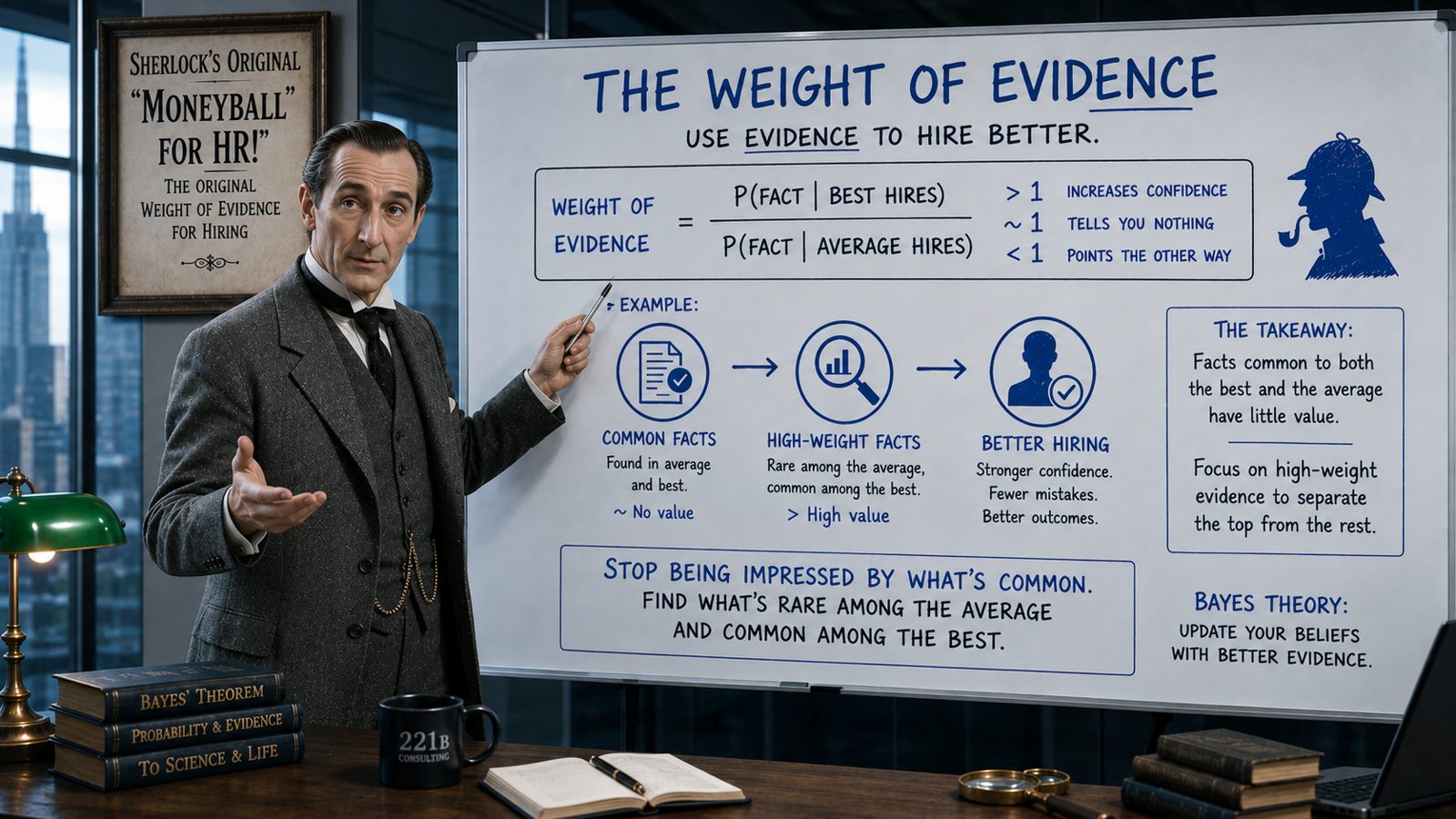
Join the Moneyball for HR! Quality of Hire study
Sports analytics works because every play is recorded and every prediction can be checked. Hiring has never had that scorekeeping. This study starts it. Rate a past hire, or a candidate you're considering now, using what you knew at the time of the hiring decision, not what you learned afterward. Set the four sliders above, then tell us how it turned out. Rate as many people as you like; each rating makes the model more accurate. Participants receive a summary of the findings.
About you
Your hiring challenges
About the person you rated
Please don't include names or other identifying details about the person you're rating. Ratings are used anonymously to test the model.
Thank you. Your rating is recorded. Rating someone else, such as the opposite case to the one you just rated, makes your contribution far more useful.
Want to see where your own hiring process is losing the odds? Run the Kaizen for Hiring Audit